Short version
On 2 September, Anthropic published free, openly licensed code for two AI agents built for shops. The first sits inside a shop's website and helps customers by talking with them normally, the way a good salesperson would. The second works behind the scenes with the shop's own staff on stock, prices and campaigns, proposing changes a person approves. Shopify already runs one with real customers, Priceline rebuilt its travel assistant on it, and Visa, Mastercard and Accenture are carrying it to their merchant networks. It arrived ten weeks before Black Friday, which is not a coincidence — and last season's data explains exactly why.
Key facts
- What was released 2 September 2026: two agents plus four worked examples, under the Apache 2.0 licence — free to copy, change and use commercially Source: the published code
- What last season did AI and agents drove 20% of holiday retail sales and $262 billion in revenue, 1 November – 31 December 2025 Source: Salesforce
- Why it matters now Retailers who had an agent last season grew 6.2%, against 3.9% for those who did not — a 59% higher growth rate Source: Salesforce
What Anthropic released
On 2 September 2026, Anthropic published the working code for two AI agents built for shops, and let anyone take it, change it and use it commercially. It is not a product with a monthly fee, and there is nothing to sign up for. It is more like a set of complete, working plans: here is one we built, take it and fit it to your business.
One of the agents faces outwards and talks to customers. The other faces inwards and works with the shop's own staff. We will come to what each of them actually does, but the shape of the release matters first.
They also published four full working versions for four different industries — a shop, a travel booking site, a mobile phone operator and a ticketing site — so a company does not start from a blank page but from the example closest to its own business. The repository itself carries the Apache 2.0 licence and describes itself as a reference implementation that is "not maintained and does not accept contributions", which tells you what it is: a starting point, not a supported product. There is also a plug-in for Anthropic's own developer tool that helps a team fit the code to systems the company already has.
And the timing is not an accident. This landed roughly ten weeks before Black Friday, at exactly the moment retailers are deciding what they will have running for the busiest shopping period of the year. Hold on to that; it is the thread the second half of this article pulls.
First: what is an "agent", and how is it different from a chatbot?
The word is used constantly and rarely explained, so let us start there, because everything else depends on it.
A chatbot answers. You ask it something, it replies with words, and that is the end of its involvement. If you ask it to find you a dress, it will describe dresses, or tell you how to search for one. The work still lands on you.
An agent does the task. It takes your goal, works out the steps itself, uses whatever tools it has been given — a product catalogue, a stock system, an order history — carries out those steps, notices when one of them fails, and tries again. The difference is the difference between someone explaining how to fill in a form and someone filling in the form.
The everyday comparison is a good shop assistant. You do not give them a list of instructions. You tell them the situation — a wedding, August, outdoors, a budget — and they go away, look at what is in stock, come back with three options and a reason for each. That is an agent. What is new is that a shop can now have one of those available to every customer at once, at three in the morning.
The problem it actually solves
To see why this matters, think about what buying something online asks of you today.
You know what you want. It is usually a sentence with several conditions in it: a jacket for cycling to work in Bavarian winter, that does not look like sportswear when I take it off, under two hundred euros, and I run hot so nothing too padded.
Now look at what the website gives you. A size dropdown. A colour filter. A price slider. Maybe a category called "outerwear". Three-quarters of your sentence has nowhere to go, so you throw it away, search for "winter jacket", and start scrolling through four hundred products hoping to recognise the right one when you see it.
That is the real problem here, and it has nothing to do with artificial intelligence being clever. It is that the customer has to translate what they want into what the website understands, and most of the meaning is lost in the translation. Everyone who has ever shopped online has had the experience of knowing exactly what they wanted and being unable to describe it to the search box.
The shopping agent removes the translation step. You say the whole sentence, conditions and all, and something on the other side actually understands it.
Step by step, from a sentence to a paid order
Here is the entire journey, and where it deliberately stops.
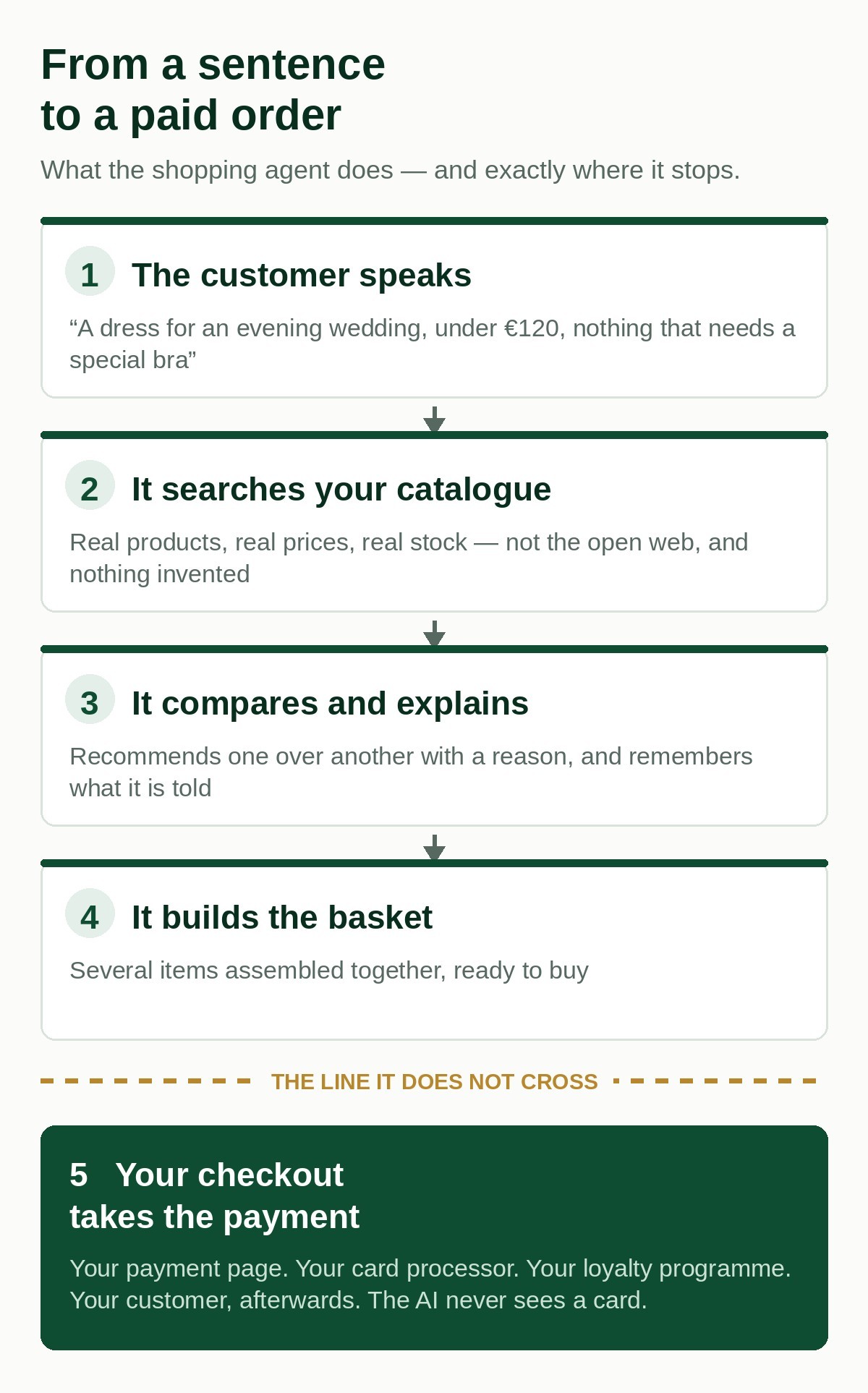
Walking through it:
- The customer speaks normally. The whole request, including the parts a filter has never had a box for.
- The agent searches the shop's real catalogue. This detail matters more than it sounds. It is not searching the internet and it is not making things up from memory — it is looking through the actual products that shop actually sells, at the actual prices, with the actual stock levels. Anthropic says the blueprint's guardrails limit the agent to real catalogue data and are meant to prevent manipulative upselling, as Quartz reported on the launch. That is the vendor's description of its own guardrails; nobody outside Anthropic has tested them.
- It compares and explains. Not just a list of results — a recommendation with a reason. "This one, because it is the only one in that price range that is not padded." And it carries preferences forward: told once that a customer never wears yellow, it should not show them yellow next season.
- It assembles the basket. Several items at once if the request needs them — the dress and something to wear over it — rather than one search at a time.
- Then it hands over. The basket goes to the shop's own checkout page, and the customer pays exactly the way they always have.
That last step is the one to hold on to. The agent is a very good shop assistant. It is not holding anybody's card.
The two agents, side by side
The release contains two quite different things, and most coverage only talks about the first.
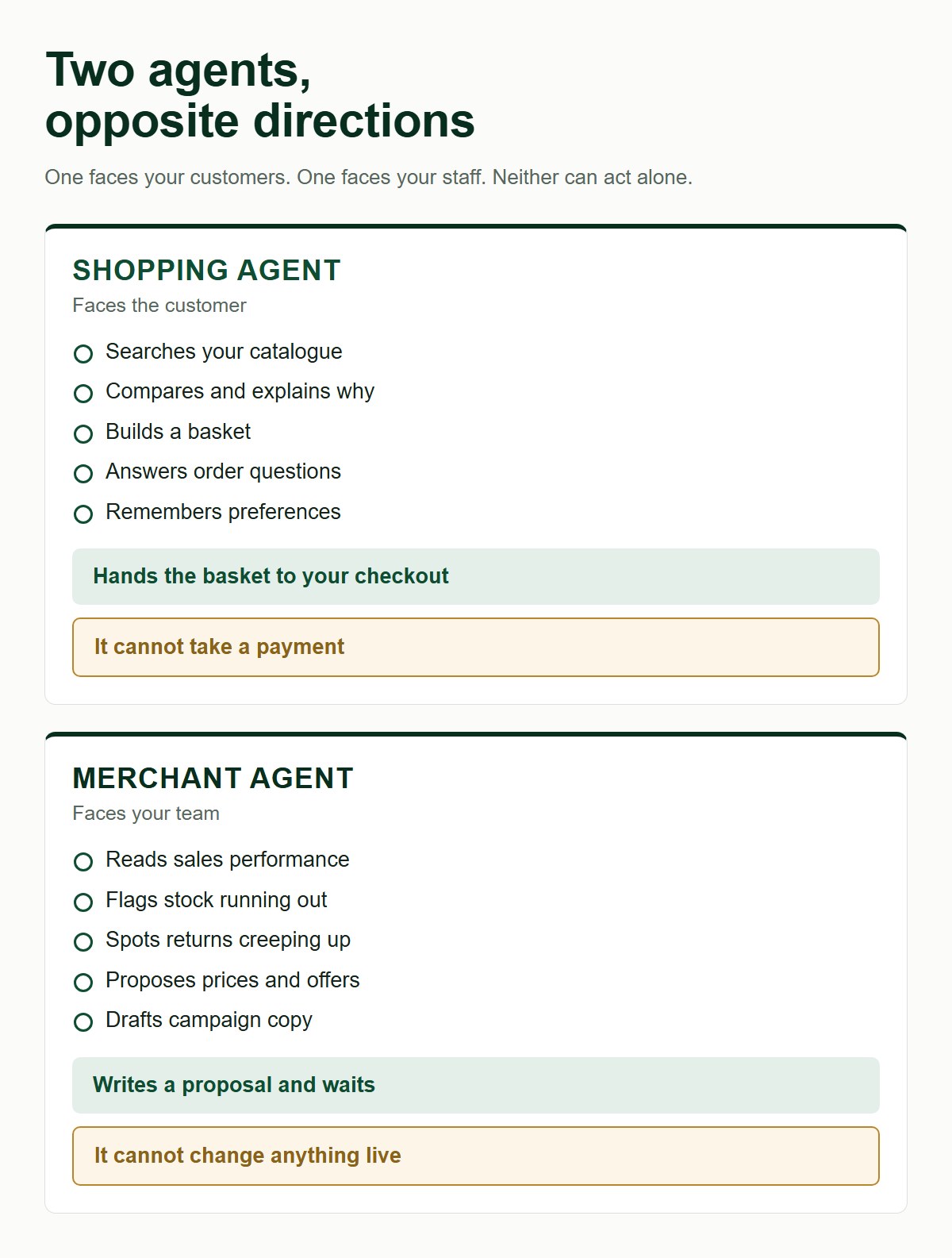
The shopping agent is the visible one, and the one customers meet. The merchant agent never speaks to a customer at all — and it is probably the more valuable of the two.
The back-office agent, explained slowly
Every shop, of any size, has a version of the same Monday morning. Somebody opens the reports and tries to notice things. Which products are selling faster than expected. What is about to run out. Which item is quietly being returned twice as often as it was a month ago. Whether last week's promotion actually made money.
This is genuinely hard work, and it fails in a specific way: the problems are cheap to fix in week one and expensive to discover in week six. A product that goes out of stock on Thursday and gets noticed the following Tuesday has cost real money. A rising return rate that nobody spots for a month has cost more.
The merchant agent does the noticing. It reads the sales data, tracks stock, flags what is about to run out, spots the returns creeping up, suggests a price change or a promotion, and drafts the campaign copy to go with it.
And then it stops, which is the part worth understanding properly.
Everything it comes up with is a proposal. It is written down, it sits there, and nothing happens until a person looks at it and approves it in the company's own system. The agent cannot change a price. It cannot publish a campaign. It cannot restock anything. It can only put a suggestion in front of a human being.
This is not a promise in a brochure; it is how the code is built. The repository states it in one line: "Nothing places an order, charges a card, or changes a live listing." Every change the merchant agent proposes is staged, waiting for a person.
There is a detail here that anticipates the obvious trick: an approval typed into the chat counts for nothing. You cannot talk the agent into believing it has permission. The only thing that counts is a person pressing approve in the shop's own systems. That single design choice is what makes this deployable in a business that has auditors, and it is worth asking about whenever anyone offers you an AI agent for anything.
Who is already using it
This is what separates a real trend from an announcement, and the list is more substantial than most launches manage.
| Company | What they are actually doing |
|---|---|
| Shopify | Runs a live shopping agent on Claude with real customers, and has published its own code showing how to connect an agent to a storefront |
| Priceline | Rebuilt its existing travel assistant, Penny, on Anthropic's models |
| Visa and Mastercard | Working with Anthropic to bring the blueprint to their clients and their merchant networks |
| Accenture | Taking it to its consumer-goods clients as an implementation partner |
| Square, Intuit, Wix, Klaviyo, Zomato, Fetch | Named in the announcement as building on or backing the approach |
Partner roles as described in Anthropic's own announcement and in PYMNTS' write-up of it, both read 6 September 2026. Every one of these is the vendor's account of its own launch; none of it is independent.
Read that list by category rather than by name, because the categories tell you more.
Shopify and Priceline are proof. They are not testing it in a lab; they have it in front of paying customers, which means it survives contact with real catalogues, real stock and real people being unreasonable.
Visa and Mastercard are distribution. This is the part most people skim past. Those two companies sit between the payment and millions of merchants, and they have relationships with shops that will never read a technical announcement. Their involvement is how something like this reaches an ordinary retailer.
One thing every retailer on that list checked first, and it is worth stating plainly rather than making a theme of: the agent does not touch the money. It builds the basket and hands it to the shop's own checkout. The payment, the loyalty programme and the customer relationship stay exactly where they were. For a retailer weighing this up, that is the reassurance that makes the rest of the conversation possible.
Accenture is implementation. Consultancies build practices around things they expect to bill for over years. "Commerce agents are quickly becoming a critical capability for organizations seeking to deliver the personalized, intelligent customer experiences that today's consumers expect," said Kath Gramling, Accenture's global consumer goods, retail and travel lead, in Anthropic's announcement. That is a vendor quote in a vendor announcement and should be discounted as such — but a firm that sells hours does not staff up for a fad.
Why it is free, and why now
Handing away working code is not charity. Behind it is a fight that has run for two years over one question: who stands between you and the shop you are buying from?
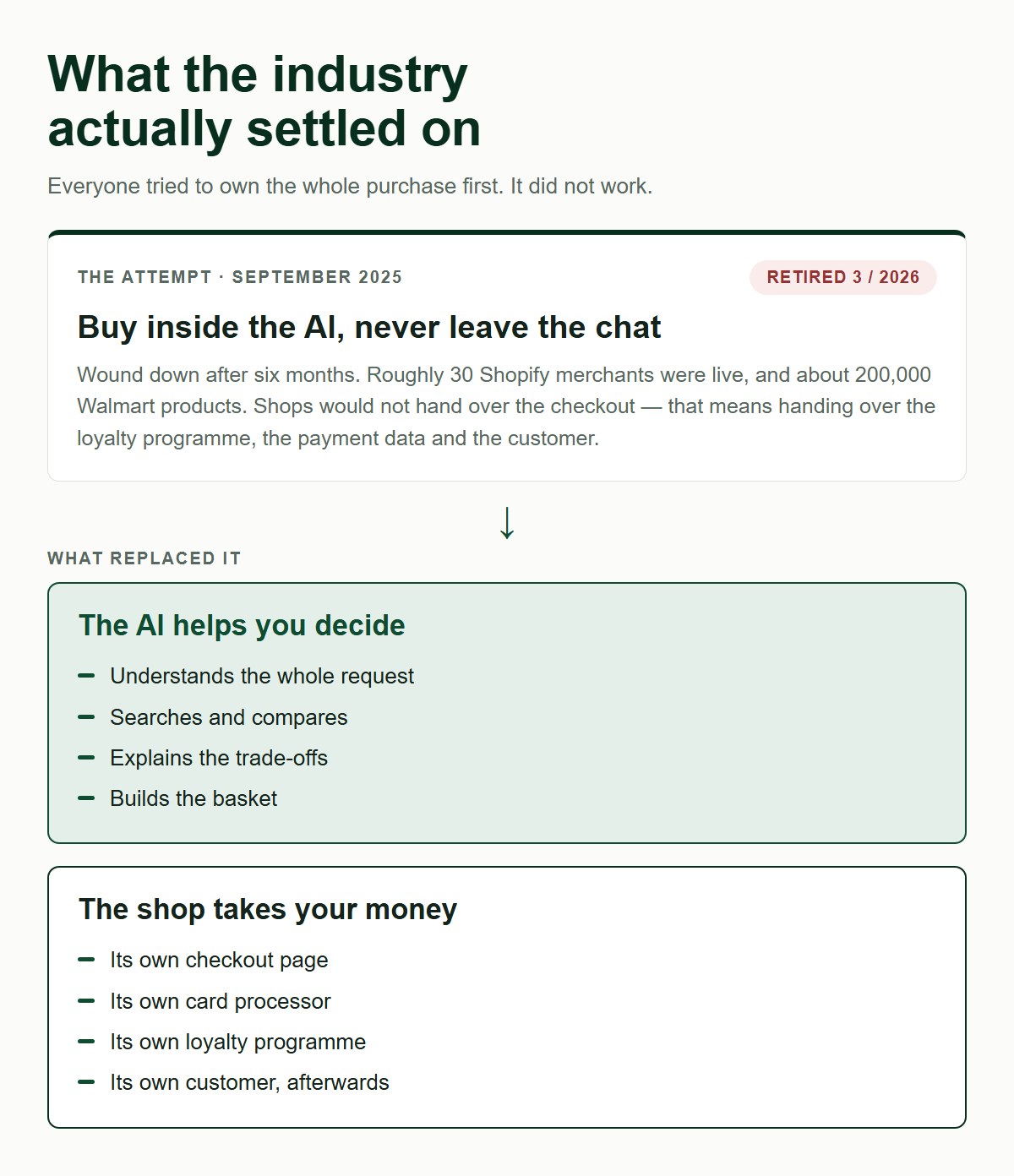
On 29 September 2025, OpenAI launched something called Instant Checkout. The idea was the aggressive version of all this: you would find the product inside ChatGPT and buy it inside ChatGPT, without ever visiting the shop's website. Etsy went live first, with Shopify's merchants promised next. The AI would not hand you over — it would complete the sale.
It did not work. Six months later, in March 2026, OpenAI wound it down. CNBC reported that Forrester's Emily Pfeiffer counted roughly 30 Shopify merchants live through Instant Checkout, against the "over a million" OpenAI had said it expected, and that Walmart confirmed it had made about 200,000 products buyable inside ChatGPT. Walmart also found that those items converted three times worse than the same products on its own site. For a company with hundreds of millions of users, those are very small numbers.
The reason had little to do with the technology. Retailers would not hand over the checkout. Handing over the checkout means handing over the loyalty programme, the payment data, the customer's email address and everything that happens after the sale — the returns, the support, the second purchase. That is not a feature a shop gives away; it is most of what a shop actually owns. Given the choice between reaching customers inside ChatGPT and keeping the relationship, retailers kept the relationship.
So OpenAI repositioned. In its own words, quoted by CNBC on 24 March 2026: "we're allowing merchants to use their own checkout experiences while we focus our efforts on product discovery." Discovery inside the AI, the transaction back on the merchant's own site. Google, the card networks and the payment processors have been building the connecting plumbing around exactly that division ever since. The argument now is about how the two halves talk to each other, not about who owns the sale.
Which means Anthropic's missing checkout is not caution and not something to be added in version two. It is the position the whole market retreated to, published as free code, at the moment retailers are choosing what to run for the holidays. Reading it that way turns "Anthropic made a shopping bot" into something rather more deliberate.
What "free code" really means — and what it does not
"Open source" is one of those phrases that sounds either more or less impressive than it is, depending on who is saying it, so here is the plain version.
What it means: the actual working code is published under the Apache 2.0 licence, which is the permissive kind — anyone can read it, copy it, change it and use it in a business, without paying Anthropic for the code and without asking permission. A competitor could use it. So could a shop with four employees.
What it does not mean: that it is free to run, and that it works out of the box. Two separate costs remain, and the second is the larger one.
| What is free | What still costs money |
|---|---|
| The code itself, and the right to use it commercially | The AI usage — every conversation with a customer costs a small amount |
| Four complete working examples to start from | The work of connecting it to your catalogue, your stock system, your logins and your checkout |
| A tool that helps developers fit it to your systems | Someone to look after it once it is live |
This is where optimism usually goes wrong, so it is worth being blunt: a working demo is not a working shop. The demo runs on invented products in an invented shop. Getting from there to your real catalogue, your real stock levels, your real customer accounts and your real payment page is a project with a timeline and a budget. When someone shows you the demo running, the useful question is not "does it work" — it clearly does — but "what sits between this and our systems".
What last Black Friday actually showed
So that is the release. The question is why a company would hand it away, free, ten weeks before the busiest shopping period of the year — and the answer is in what happened last time.
Before any of this year's tools existed, something had already changed, and the clearest evidence is the last holiday shopping season.
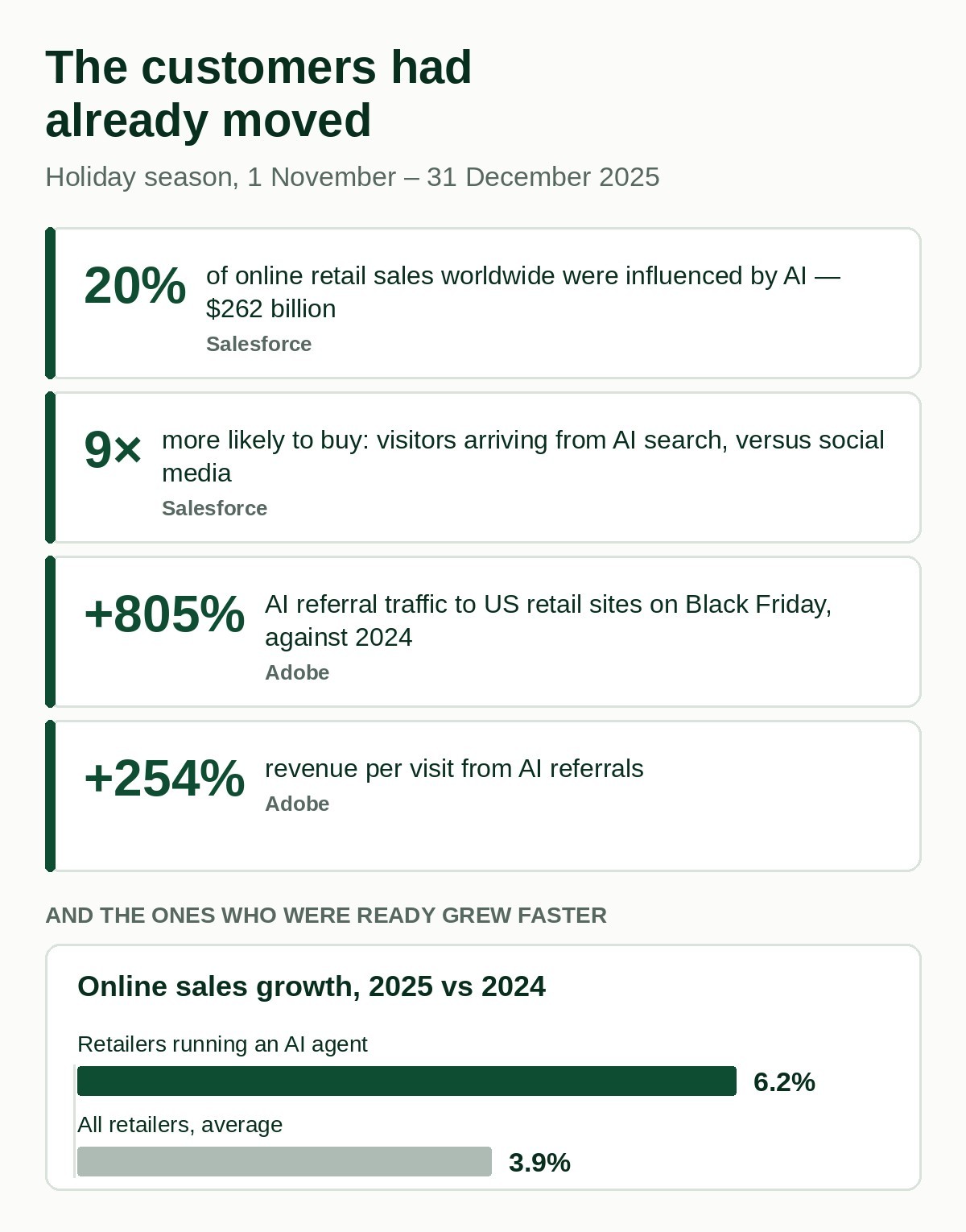
Salesforce's recap of the season, covering 1 November to 31 December 2025, puts it this way: AI and agents drove 20% of all retail sales, fuelling $262 billion in revenue, out of a global online total of $1.29 trillion — its own figures, from its own commerce platform. Read the metric carefully before you repeat it: this is sales Salesforce says AI and agents influenced, through recommendations and engagement, not sales completed inside an AI tool. Adobe, measuring traffic rather than sales, found visits to US retail sites from AI tools up 805% on Black Friday itself against the year before — that figure is Adobe's, reported by the Retail Media Breakfast Club; across the whole season Adobe put the rise at 693%.
One honest correction, because this story is often told wrongly. Classic marketing did not collapse. The season set records — $1.29 trillion of global online sales, up 7% on the year — and if AI touched a fifth of that, four-fifths of it happened without AI anywhere in the story. Anyone telling you traditional channels fell off a cliff is describing something that did not happen.
What did happen is more interesting than a collapse.
Why a small channel is worth paying attention to
Traffic arriving from AI tools is still a modest share of the total. It is also, by a wide margin, the best traffic anybody is getting.
Visitors who arrived from an AI search were nine times more likely to buy than visitors from social media, on Salesforce's measurement of the season. Adobe's numbers point the same way: those visitors spent 45% more time on retailers' sites, viewed 13% more pages, were 33% less likely to bounce straight off, and generated 254% more revenue per visit than a year earlier.
Small in volume, extraordinary in quality, growing at several hundred percent a year — that is what a shift looks like at the beginning. A channel that converts nine times better than the one everybody currently budgets for does not stay small.
And the second finding is the one to put in front of whoever approves budgets: retailers who had already built an AI agent grew 6.2% year on year, against 3.9% for those who had not — a 59% higher growth rate, again from Salesforce's own commerce data. That is not a vendor's story about an unnamed partner; it is a comparison between the shops that were ready and the shops that were not. It is still a vendor's data, and Salesforce sells the software in question — but it is an observation of a season that has already happened, not a forecast.
So the demand side moved first. What arrived on 2 September is the supply side being handed the tools to answer — free, ten weeks before it matters most.
Why this season is the one that counts
Everything so far has been about what already happened. The more useful question is what happens in the next twelve weeks — and here the argument has a specific shape rather than a general optimism.
Last season, the AI in the story sat outside the shop. Customers researched in ChatGPT or Perplexity and then arrived at a retailer's site already decided. The shop did not have an agent; it received a better-informed visitor. That is what produced the 20% influence figure and the nine-times conversion gap.
This season, the AI moves inside the shop. Salesforce, forecasting in July, expects:
| Prediction for the 2026 season | Figure | Source |
|---|---|---|
| Share of all holiday e-commerce traffic coming from AI chat agents | 20% | Salesforce, 20 July 2026 |
| E-commerce sites with a site-specific shopper agent live by Cyber Week | 1 in 3 | Salesforce, 20 July 2026 |
| Shoppers who now use an AI assistant somewhere in the buying journey | 50%, up 67% in a year | Salesforce, 20 July 2026 |
| Shoppers who say they trust product recommendations from AI chat | 74% | Salesforce, 20 July 2026 |
| Shoppers who say a brand-owned assistant makes them "much more confident" in a purchase | 41% | Salesforce, 20 July 2026 |
All five are Salesforce forecasts published on 20 July 2026, not measurements, and Salesforce sells agent software to retailers. Checked 6 September 2026.
Look at the second row again, because that is the one that connects to everything above. Salesforce expects a third of all e-commerce sites to have their own shopping agent running by Cyber Week — and it made that forecast on 20 July, six weeks before the cost of building one dropped to zero and Visa, Mastercard, Shopify and Accenture started carrying the blueprint to their merchants.
That is the join. A forecast of mass adoption, and then a sudden removal of the thing that was making adoption slow. If the forecast was right in July, it is conservative now.
The part that should worry an early adopter
There is a sting in this, and it is the most commercially useful sentence in the article.
The 6.2% versus 3.9% growth gap from last season is an early-adopter premium. It exists because almost nobody had an agent. If a third of sites have one by Cyber Week, that premium is being competed away in real time — the advantage of having one turns into the disadvantage of not.
Which reframes the decision. The question is not "will this pay off eventually". It is whether you are on the right side of a gap that is open now and closing fast. Free code, ten weeks out, is what makes the timing tight rather than comfortable.
The honest case against
Three reasons this could be less dramatic than it sounds, and they deserve to be stated as clearly as the case for.
- These are Salesforce's forecasts, and Salesforce sells agent software. The same discount applies as to Anthropic's 35% and 60% — with the difference that the 6.2 versus 3.9 figure is an observation of last season rather than a prediction about this one.
- Integration timelines are stubborn. A retailer deciding in September rarely ships for November. Much of the adoption forecast will be simple chat widgets rather than agents that genuinely search a live catalogue, and the two will get counted the same way.
- Volume is still small. Adobe's 693% season rise is growth from a low base, and the base of AI users grew fast over the same period, which flatters any referral figure. A channel can convert nine times better and still be a minority of your revenue for another two seasons.
What to actually watch in December
If you want to know whether this thesis was right rather than repeat it, these are the numbers to check when the season data lands:
- Did AI traffic reach 20% of the total? The headline forecast, and the easiest to check.
- Did the growth gap widen or narrow? If it narrows, agents became table stakes and the advantage is gone. If it widens, execution quality is what separates shops, not whether they have one.
- Did returns rise faster than sales? Last season, Salesforce counted more than $181 billion of returns — 14% of everything bought, up 10% on the year. Bigger baskets from persuasive agents are exactly the thing that shows up here first.
- Did anyone publish a figure that was not their own product's? Every number in this article comes from a company with something to sell. Independent measurement is the thing this field is still missing.
What it does to a shop
If customers increasingly arrive having already described what they want to something that understood them, several things a retailer spent a decade building start to matter less — and a few things they have neglected start to matter a great deal.
- Search stops being the front door. The category tree, the filter sidebar, the carefully tuned facets were all built so a person could narrow down a list. If the narrowing happens in a conversation instead, that machinery becomes plumbing rather than storefront.
- Product descriptions stop being written for humans. They become the material an agent compares. A product with three lines of marketing copy and no real detail is not badly presented any more — it is unpickable. It loses to the one that says what the fabric actually is, because that is what the customer's sentence asked about.
- The best answer beats the best ranking. Being found has been a marketing discipline: keywords, bids, placement. Being chosen by something comparing on the merits is a merchandising discipline. Different budget, different team.
- Data quality becomes a sales channel. Stock levels that are roughly right, attributes half filled in, sizing that varies by supplier — all survivable while a human squints at photographs, all fatal once something is comparing on the attributes.
- The salesperson does not disappear. They get the questions that stayed hard: the ones with judgement or discretion in them.
None of this requires you to build an agent. It happens because your customers are using someone else's.
The numbers, read carefully
Two figures are travelling with this announcement. Anthropic's own announcement puts it in one sentence: "Retailers running shopping agents on Claude have seen carts up to 35% larger and shoppers 60% more likely to complete a purchase." That is a vendor claim about the vendor's own product, and it is worth stating precisely, because the precise version is noticeably weaker than the version being repeated.
What the coverage disagrees on
The disagreement is about how many retailers those figures describe. Anthropic's sentence says "retailers", plural. Speaking to reporters on the same launch, Angela Jiang, Anthropic's head of product for the Claude platform, scoped it to one: cart sizes grew roughly 30 to 35% for one partner using a commerce agent built on Claude, with customers about 60% more likely to complete a purchase — as Quartz reported it, citing Reuters. Anthropic has not published anything that reconciles the two. Until it does, the narrower version is the one the evidence supports.
The second thing worth untangling is that the season's headline conversion numbers measure different things. Salesforce's "nine times" compares AI-search referrals against social media referrals; Adobe's figure is 31% better than all other traffic sources. Both are true and neither is the other. Anyone quoting "nine times" as a general uplift is quoting the wrong comparison.
So, on the cart figure: one partner. Not named. No time period. No comparison baseline. No product category. Reported by the company selling the technology.
That is not an accusation — it is simply what an early launch figure looks like, and every vendor publishes them. But "one partner saw 35%" and "retailers see 35%" are different sentences, and only the first one is supported by anything.
If you do test this yourself, there is a number nobody quotes that matters more than either of these. Returns. Salesforce put global holiday returns at more than $181 billion — 14% of everything bought, up 10% on the year before. An agent that is very good at persuading people into larger baskets which they then send back has taken money and goodwill out of the business while making the conversion dashboard look magnificent. Measure basket size, completion rate and return rate together, over the same period, or you genuinely will not know what you have built.
What it actually contributes
Three things, in descending order of how much they matter.
| What it gives you | What it replaces | Who benefits most |
|---|---|---|
| A working starting point, free | Six to twelve months of an internal team designing one from scratch | Mid-sized shops with no AI team — the ones who were never going to build this at all |
| Search that understands a whole sentence | Filters and a search box that fail on any request with a condition in it | Anyone with a large or hard-to-navigate catalogue |
| Someone watching the numbers every day | A person reading dashboards and hoping to catch the problem early | Small operations teams looking after too many products |
The first row is the real one. This capability already existed at large retailers who could afford to fund it. What changed on 2 September is that the starting point became public and free — which moves it from "companies with an AI team" to "companies willing to run an integration project".
What is not included
Short and important. The blueprint is the reasoning layer. It sits on top of your systems, and it assumes those systems exist. You still need to provide, or build:
- Customer logins — the examples have no authentication at all, which is the single biggest gap between the demo and anything you could put in front of a customer.
- The connection to your catalogue and stock, so it is looking at real products and real availability.
- Your business rules — who is eligible for what, what may be discounted, fraud checks. The agent knows what a valid request looks like; only you know whether it is allowed.
- The checkout and the payment, which stay entirely yours.
- A decision about the memory feature. If the agent remembers customer preferences, that is personal data, with all the retention and deletion obligations that come with it in Europe. Worth settling with whoever owns data protection before it is switched on rather than after.
Where to start, and what to hold back
If you sell anything online, the useful question is not whether to do this but which part first.
| Sensible first | Hold back |
|---|---|
| Helping customers find the right product in a large catalogue | Anything that moves money, or changes an order after it is placed |
| Order status, returns policy, opening hours, standard questions | Deciding whether a refund or a warranty claim is granted |
| Flagging stock that is about to run out | Applying a price change without a person seeing it |
| Drafting campaign copy and the weekly summary for a person to edit | Publishing anything to customers unreviewed |
The right-hand column is not a list of things AI is bad at. It is a list of things where being wrong is expensive to reverse — money moved, a price published, a commitment made to a customer. That test is simple, it requires no technical knowledge to apply, and it will still be the right test when the next announcement arrives.
Watch it from the source
Two things are worth going to directly rather than reading about.
Official session
Anthropic runs a live session called Building Claude Commerce Agents on 10 September 2026, 11:00 to 11:45 Pacific time, presented by Ali Shazal from its applied AI team and Nick Hernandez, its go-to-market lead for commerce. It walks through the blueprint with live demonstrations. Registration is required; the page states that the recording is not available yet and that attendees are sent a link within 48 hours of the event. Checked 6 September 2026 — there is no public video version.
The second is the demonstrations themselves. All four working versions — the shop, the travel site, the mobile operator and the ticketing site — are in the published code, and someone technical on your team can have one running on their own machine in an afternoon. That is a far better basis for a decision than any article, including this one.
Bottom line
Two things are worth taking away.
The practical one: talking to a shop the way you would talk to a person has stopped being something only the largest retailers can afford. The starting point is free, Shopify and Priceline are proof it survives real customers, and Visa, Mastercard and Accenture are pushing it towards shops that have never heard of any of this. If you sell online, it is on your roadmap whether or not you put it there.
The strategic one, and the more interesting: every large AI company spent last year trying to own the transaction. The one that tried hardest gave up after six months, because shops would not surrender the checkout and everything attached to it. What Anthropic published is the version that survived that argument — the AI helps you decide, and the shop still takes your money.
And the timing one. Last season proved the customers had moved, and rewarded the few shops that were ready with nearly double the growth of everyone else. Salesforce expects a third of sites to have an agent by Cyber Week — a forecast made before the code became free. That advantage is an early-adopter premium, and premiums do not survive a third of the market arriving. The interesting question about this Black Friday is not whether AI matters. It is who spent September building and who spent it reading about it.
For once, a boundary was drawn on purpose, and it was drawn where the customer relationship already was. Whether it holds as these tools get better is the real question underneath all of this. But it is a good deal more thought than this industry usually gives to where an agent should stop.
FAQ
What is the difference between this and a chatbot?
A chatbot answers questions with words. An agent does the task — it searches the real catalogue, compares products, builds the basket and answers order questions, using the shop's actual systems rather than describing what you should do.
What exactly did Anthropic release?
Code for two agents — one facing customers, one facing staff — published on 2 September 2026 under the Apache 2.0 licence, with four complete working examples for retail, travel, telecom and ticketing, plus a plug-in that helps developers fit it to existing systems. The repository describes itself as a reference implementation that is not maintained.
Who is already using it?
Shopify runs a live customer-facing agent on Claude and has published its own integration code. Priceline rebuilt its assistant Penny on Anthropic's models. Visa, Mastercard and Accenture are taking it to their networks and clients, and Square, Intuit, Wix, Klaviyo, Zomato and Fetch are named in the announcement.
Can it take my money?
No. It builds the basket and hands it to the shop's own checkout, where you pay as usual. The payment, the loyalty programme and everything after the sale stay with the retailer.
Why would Anthropic leave out the checkout?
Because the alternative failed in public. OpenAI's Instant Checkout let people buy inside ChatGPT and was wound down in March 2026 with roughly 30 Shopify merchants live and about 200,000 Walmart products available, because retailers would not give up the checkout. The industry settled on discovery in the AI and payment on the shop's own site.
Can it change prices on its own?
No. The back-office agent only writes proposals, and a person must approve them in the company's own system. An approval typed into the chat does nothing.
Are the 35% and 60% figures reliable?
The sources differ on their scope. Anthropic's announcement says "retailers running shopping agents on Claude have seen carts up to 35% larger and shoppers 60% more likely to complete a purchase"; its head of product for the Claude platform described the same figures as roughly 30 to 35% larger carts for one unnamed partner. No period, baseline or category is given either way. Treat them as a reason to measure rather than as a forecast.
If the code is free, what does it cost us?
Two things: the AI usage every conversation consumes, and the integration work to connect it to your catalogue, stock, logins and checkout. For most companies the second is much larger than the first.
How long would it take to deploy?
Longer than the demo suggests. The examples have no customer logins and run on invented products. Treat the demo as a starting point, not as a head start on the schedule.
Will this season really be bigger?
Salesforce forecasts that 20% of all holiday e-commerce traffic will come from AI chat agents and that one in three sites will have a site-specific shopper agent live by Cyber Week — a forecast published on 20 July 2026, before the code to build one became free. Those are a vendor's predictions, and worth discounting as such, but the mechanism behind them is straightforward: the barrier to building one was removed ten weeks before the season.
Is there anything to watch?
Anthropic's session "Building Claude Commerce Agents" on 10 September 2026 includes live demonstrations. Registration is required and the page said, when checked on 6 September 2026, that no recording was available yet. The four working examples in the published code can also be run locally.
ISA After Hours · Augsburg
Want to work out which announcements actually matter?
ISA After Hours is a community of Israeli and international tech professionals in Augsburg. We meet after work, take these releases apart against real projects, and say plainly which ones change anything.
Join ISA After Hours →Sources
- salesforce.comSalesforce, Caila Schwartz (20 July 2026): 2026 holiday predictions — 20% of traffic from AI agents, one in three sites with a branded shopper agent by Cyber Week
- salesforce.comSalesforce: 2025 holiday shopping data — the $262bn influenced by AI, the 9× conversion gap, and the 6.2% vs 3.9% growth split
- digitalcommerce360.comDigital Commerce 360, on Adobe Analytics: AI referral traffic growth, conversion and revenue per visit
- pymnts.comPYMNTS: Anthropic built the shopping brain and skipped the wallet — the partner list and the payments strategy
- qz.comQuartz: Anthropic releases AI shopping agent blueprints for retailers — Angela Jiang on the cart and conversion figures
- cnbc.comCNBC (24 March 2026): OpenAI revamps shopping in ChatGPT after struggling with Instant Checkout — OpenAI's own wording on handing checkout back to merchants
- cnbc.comCNBC (20 March 2026): OpenAI's first try at agentic shopping stumbled — the ~30 Shopify merchants, the ~200,000 Walmart products, and Walmart's 3× worse conversion
- techcrunch.comTechCrunch (29 September 2025): OpenAI takes on Google and Amazon with a new agentic shopping system — the Instant Checkout launch
- retailmediabreakfastclub.comRetail Media Breakfast Club (2 December 2025), on Adobe Analytics: AI-driven traffic to US retail sites up 805% year on year on Black Friday
- digitalcommerce360.comDigital Commerce 360: Anthropic debuts Claude features focused on agentic commerce
- anthropic.comAnthropic: "Building Claude Commerce Agents" — the official session and its recording
- claude.comAnthropic: the announcement itself
- github.comThe published code and the four runnable examples