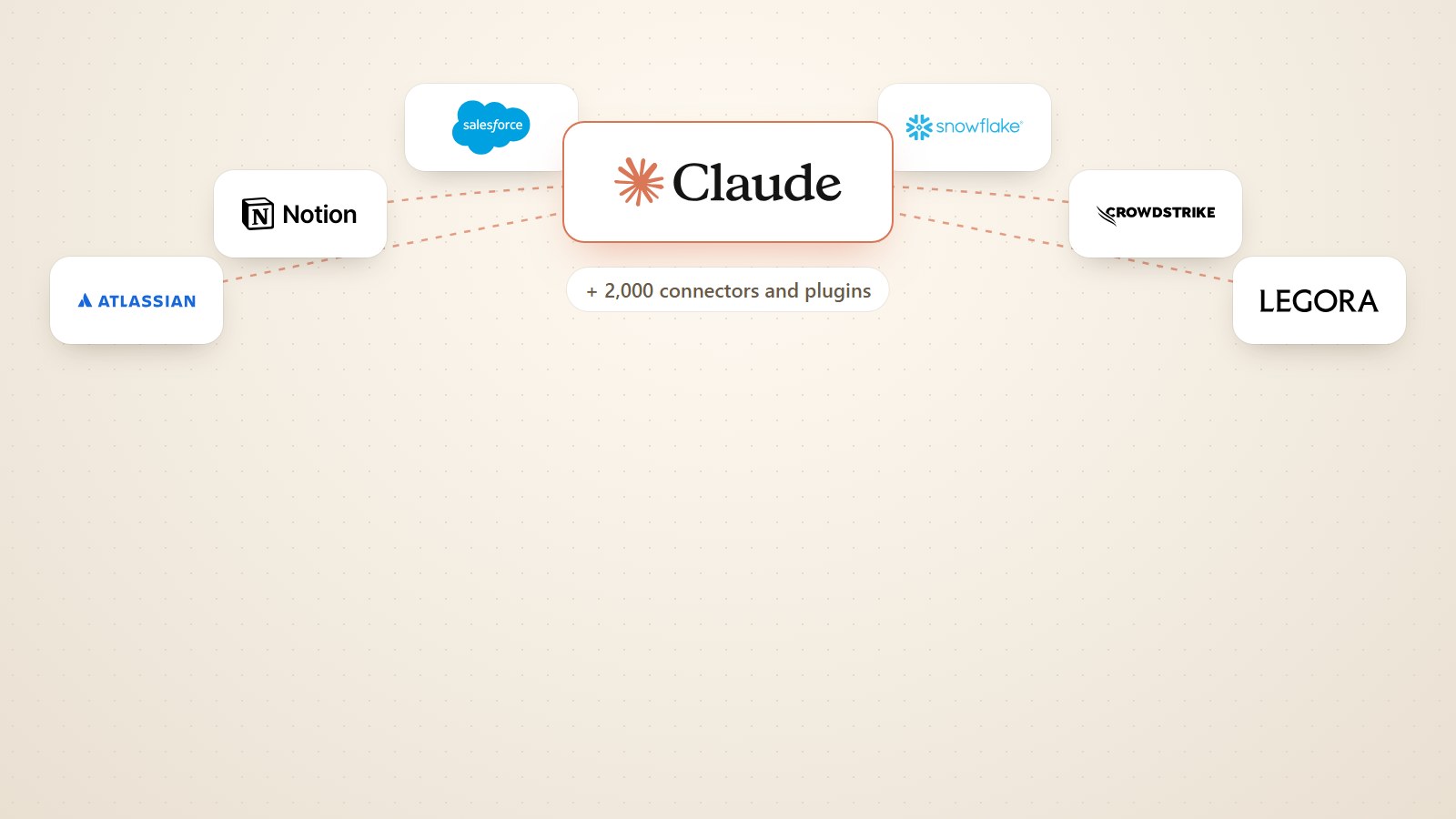
Short version
The Claude Marketplace is one catalogue for three things: connectors and plugins that link Claude to the tools you already use, ready-made software built on Claude, and consulting firms that help companies roll it out. The connectors are open to every Claude user. The software is bought by companies out of the budget they have already promised to Anthropic. So it works like an app store for people and like a procurement shop for companies.
One shop for everything Claude connects to
 Marketplace · live since 23 September 2026
Anthropic's announcement is one sentence long at its core: "Starting today, the Claude Marketplace brings plugins and connectors, agents and products, and service partners into one place." Until now these lived in different corners. Connectors had their own directory inside Claude, partner software was bought through separate deals, and consulting firms were found through Anthropic's partner programme.
A connector is a bridge between Claude and another tool, such as Google Drive, Jira or Salesforce, so Claude can read what is there and act on it for you. An agent is an AI that carries out a task step by step on its own, using the tools you give it. The marketplace puts both, and the people who install them, behind the same front door.
The idea is not brand new. Anthropic opened a small version in March, as a limited preview for large customers with six partners: GitLab, Harvey, Lovable, Replit, Rogo and Snowflake. What changed this week is the scale, and the fact that the connectors everyone uses now sit in the same shop as the software companies buy.
What this means for you: the question "can Claude work with our tools?" now has one place to check, not a web search.
What's on the shelves
The shop has three shelves. Anthropic names the partners on each in its announcement.
1. Connectors and plugins
Link Claude to the tools you already use. Open to every Claude user.



Also Google, Microsoft, Slack, Figma and more than 2,000 others.
2. Agents and products
Software built on Claude, which companies can pay for out of their Anthropic budget.




Also Cursor, Harvey, Lovable, GitLab and Vercel.
3. Service partners
Consulting firms and system integrators who plan and install Claude inside a company.
Accenture, Boston Consulting Group, Deloitte and other members of the Claude Partner Network.
Connectors and plugins are the shelf most people will use. Anthropic counts more than 2,000 of them, and connectors from the directory are "available for all users" of Claude, on the web, the desktop app and the phone. At work there is one extra step: on a Team or Enterprise plan, an owner of the company account has to switch a connector on before colleagues can use it.
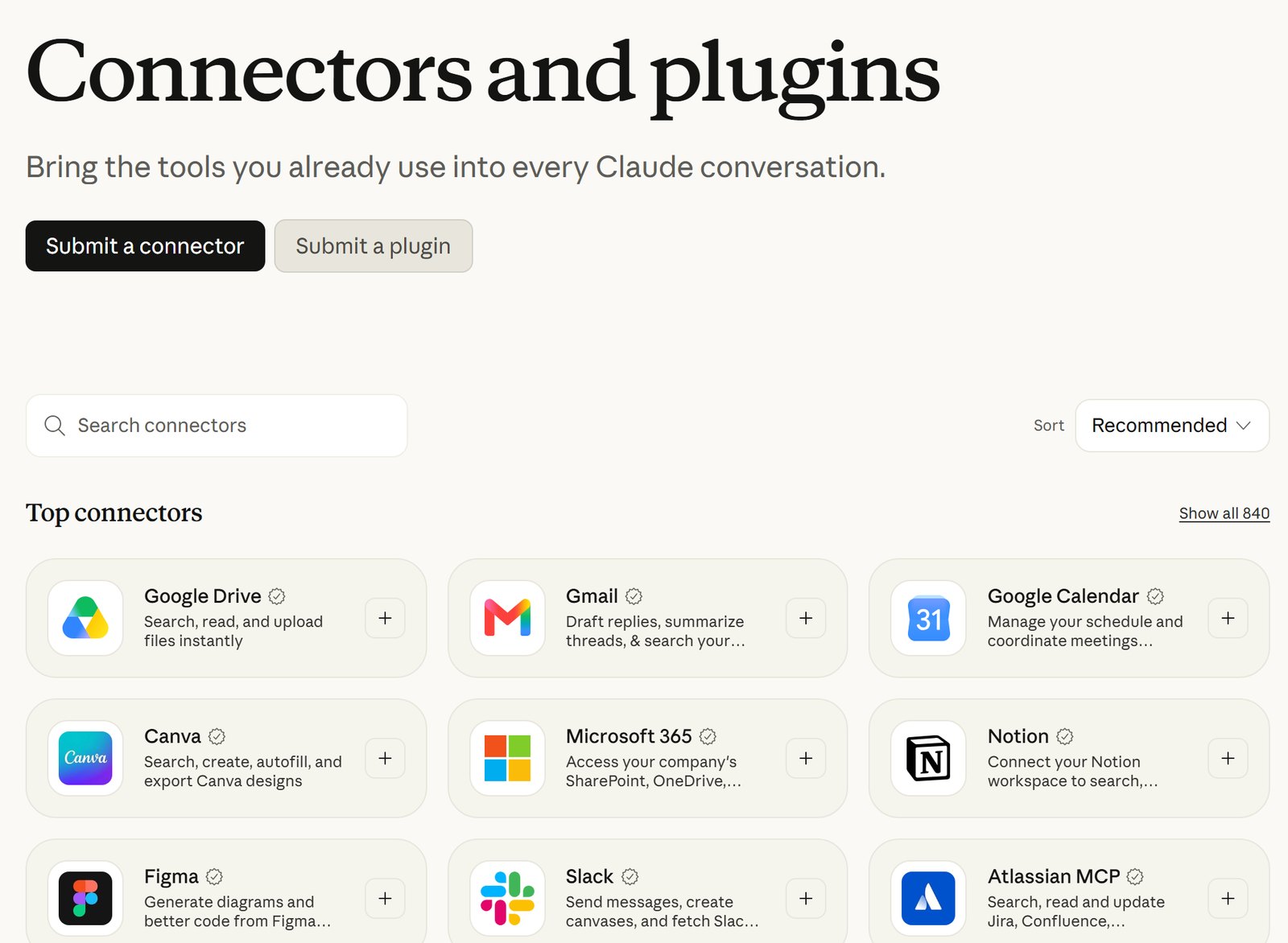
That tick matters, because a connector gives Claude access to your data in that tool. Anthropic's documentation explains that verified connectors "have been tested by Anthropic for quality and compatibility", while community connectors are screened before listing but not reviewed in depth. It also says plainly that verification "is not a security audit". The shop is tidier than the open web. It is not a guarantee.
Agents and products is the shelf with a price tag. Big customers usually sign a commitment with Anthropic: a promise to spend a set amount over a year or more. The marketplace lets them "use a portion of your committed Anthropic spend on Claude-powered software" from partners. Anthropic's examples: the code-review company CodeRabbit put part of its commitment towards Vercel, where its agents run, and Power Digital and ThoughtSpot put theirs towards Snowflake, where their data lives. Anthropic does not say how large that portion can be.
Service partners are the people, not the software: consulting firms from the Claude Partner Network who help a company plan and install Claude.
What this means for you: the first shelf is for you, today. The other two are for whoever in your company owns the AI budget.
So is it the App Store of AI?
In some ways it already behaves like one. Developers submit their connectors and plugins for listing, Anthropic labels the ones it has checked, and the order you see them in follows popularity. Anthropic's own documentation makes the comparison: "Ranking is usage-based, similar to other app stores."
But the App Store is a shop where you pay with your own card. The buying side of the Claude Marketplace works differently. The button on the software shelf says "Request to buy", and the money comes out of a company's contract with Anthropic. The model Anthropic itself points to is not Apple but the cloud marketplaces run by Amazon Web Services and Microsoft Azure, where companies spend money they have already committed. When the preview opened in March, The Next Web reported one difference: Amazon and Microsoft typically take 3 to 15% of every sale, and Anthropic was taking nothing.
Anthropic is not alone in trying to become the place where AI tools are found. Microsoft runs an Agent Store inside Microsoft 365 Copilot, and OpenAI opened an app directory inside ChatGPT in December 2025, built around everyday apps such as Canva and Expedia, as The Next Web notes. Each wants to be the front door. Whichever shop companies and developers fill first is likely to keep them.
So the honest answer to the question is: half of it is. For a person, the connectors shelf works like an app store, open, free to browse and ranked by use. For a company, it is a procurement shop. Time will tell which half matters more. The first sign will be whether the software shelf grows the way the connectors shelf already has.
What this means for you: you do not need to wait to find out. The part that is an app store is already open to you.
What it means for you on Monday
Look up your own tools. In Claude, open Customize, then Connectors, and check which of the tools you use every day are there. Start with one, such as your calendar or your shared drive, and ask Claude something only that tool knows.
Prefer the verified ones. A connector can read what is in the tool it connects to. Look for Anthropic's badge, and for company data check with whoever looks after data protection at your workplace before you connect it.
At work, use the Request button. On a Team plan, if you cannot switch a connector on yourself, the Request button sends it to your admins. That is quicker than an email.
If your company already pays Anthropic, mention the shop. Ask whoever owns the contract whether a tool you already pay for separately, such as Cursor, GitLab or Snowflake, could come out of the same budget. That is exactly what the marketplace was built for.
Official sources
- claude.comAnthropic: "Claude Marketplace: plugins and connectors, products and agents, and service partners", 23 September 2026
- claude.comClaude Marketplace: connectors and plugins
- claude.comClaude Marketplace: agents and products
- claude.comAnthropic documentation: the connectors directory, verified and community connectors
- support.claude.comClaude Help Center: use connectors to extend Claude's capabilities
- learn.microsoft.comMicrosoft Learn: Agent Store in Microsoft Copilot
- venturebeat.comVentureBeat: Anthropic launches Claude Marketplace (the March 2026 preview)
- thenextweb.comThe Next Web: Anthropic launches marketplace for Claude-powered software, March 2026