
Today: how Grok Bot does your shopping
Say you message Grok Bot: "Order me running shoes, size 44, under €120, delivered by Friday." Each Bot has its own computer in the cloud with a web browser, and for a shop with no ready-made connection it uses that browser the way you would (xAI documentation). We tested what Grok Bot is good at in our Grok Bot guide.
So it opens the shop and clicks the cookie banner away (in Germany there is always one). It types "running shoes" into the search box and looks at a screenshot of the results. It opens a product, finds the size picker and works out from the picture whether 44 is greyed out. It clicks "add to cart", closes the newsletter pop-up, and does the same at two more shops to compare prices. When it reaches payment it stops and hands you the controls: xAI's own documentation lists "a payment or identity check" as a moment the Bot pauses for a person (xAI documentation).
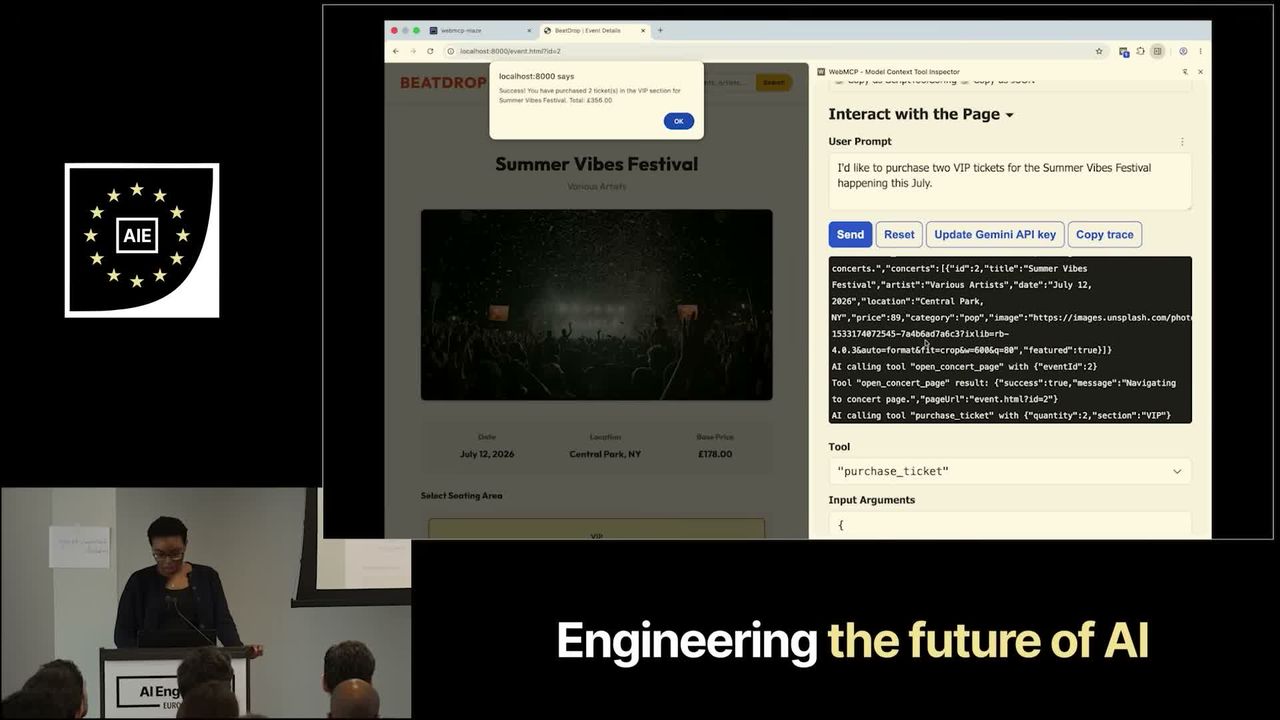
It works, but every step is a guess about a page designed for human eyes. In the talk above, Google's Tara Agyemang walks through the same problem with concert tickets: the agent reads the whole page, works out where to click and clicks, and if a banner pushes the page down at the wrong moment, the click lands in the wrong place (video, 1:45). Even xAI tells its users to avoid the clicking when they can: "Prefer a connector when one is available: it is often more reliable than clicking through a website" (xAI documentation).
The same errand on a shop with WebMCP
WebMCP is that more reliable path, offered by the shop itself. The site publishes a short menu of actions, each with a plain description, and an agent picks from it instead of clicking. Since 5 August every standard Shopify store offers ten of them, with "nothing to install or configure" for the shop owner (Shopify). Here is the shoe errand again on such a shop:
An agent that clicks
How Grok Bot shops today
- Open the shop, close the cookie banner
- Type "running shoes", screenshot the results
- Open a product, read the size picker from the picture
- Click "add to cart", close the pop-up
- Page changed or button moved? Look again, try again
- Find checkout, hand you the controls to pay
An agent that reads the menu
The same errand with Shopify's WebMCP actions
- Search the catalogue: "running shoes"
- Get product details: prices and stock for each size come back as plain facts, so size 44 is either there or not
- Update the cart: one pair, size 44
- Go to checkout: you check and pay
No screenshots, no banners, no guessing which grey box is size 44. The festival demo in the video works the same way: one sentence from the user, then three actions ("search concerts", "open the concert page", "buy tickets: 2, VIP"), and the shop confirms. And in this flow the agent does not pay: Shopify's checkout action only takes you to the checkout page.
What is WebMCP, technically? A draft standard written by engineers at Google and Microsoft in a W3C group, the body that sets web standards. It is not final yet (WebMCP draft). The name comes from MCP, the way AI assistants already plug into apps like your calendar or Google Drive, moved into the open browser tab. As a user, you install nothing: the shop offers the menu, and your agent either reads it or does not.
Five errands that change
- Shopping on a Shopify storeReal
Find a product, check your size is in stock, put it in the cart, get to checkout. Agents can do this on every standard Shopify store since August (Shopify). - "Can I return these if I have worn them once?"Real
Today the agent hunts through the footer for the returns page. With WebMCP, Shopify stores answer questions about "returns, shipping, and hours" straight from their own policy pages (Shopify). - Small online shops, switched on at onceReal
On 21 October Cloudflare reported that Commerce.com turned it on across "almost 100,000 domains": an agent can "search products, check details, build a cart, and get a checkout link", and you finish the purchase yourself (Cloudflare). - Concert tickets, flights, hotelsTesting
The video shows a demo ticket shop. Google says Expedia, Booking.com, Etsy, Instacart and Target are among the companies "experimenting with WebMCP" (Google, 19 May 2026). None of them has announced that it is switched on for customers. - Appointments and long formsNext
A doctor's booking page, a Bürgeramt slot, an insurance form with forty fields. In the talk, Agyemang names financial forms and multi-step sites as obvious next cases (video, 11:20). No German authority or doctor platform has announced it, so this is what it could do once a site adds it.
Which agents can use it today
- ChatGPT: yes, in the desktop app. OpenAI calls them "site tools". The browser inside the ChatGPT desktop app uses them when a site offers them, each action gets a safety check first, purchases still need your confirmation, and in company accounts an administrator has to allow it (OpenAI).
- Gemini in Chrome: announced, not shipped. Google said in May that Gemini in Chrome "will soon support WebMCP" (Google). The sources disagree on where it stands: the webmcp.com tracker expects it in early 2027, and one industry blog says it already works. We found no Google announcement that it has shipped.
- Grok Bot: not yet. It shops by clicking through its browser, and xAI's documentation does not mention WebMCP (xAI).
- Claude: no announcement from Anthropic that we could find.
On the browser side, Chrome is still testing it with real sites. On 28 September Google extended the test to Chrome 162 because feedback led to changes in the design (Chromium developer list). Apple's Safari team formally opposes it. Its view is that an agent is a kind of assistive technology, so websites should fix the labels they already write for blind users' screen readers rather than build a second door (WebKit). Firefox's makers are neutral (Mozilla).
What it means for you
- If you let an AI shop or book for you, errands on shops that offer the menu should get faster and break less. Grok Bot will keep clicking until xAI adds support, which works on most shops. Either way, the agent stops before payment, so read what you are confirming: size, quantity, delivery date.
- If you sell on Shopify, it is already on. The agent now reads your product data and policies directly, so wrong stock, missing sizes or a vague returns page cost you sales from agents as well as people.
- If you own a company website, there is no need to build anything yet; the standard is a draft and Safari opposes it. Two cheap steps meanwhile. Fix the accessibility labels, which helps agents today and helps people (in Germany, many online shops must be accessible under the Barrierefreiheitsstärkungsgesetz anyway). And write down the three errands customers would most like to hand to an agent on your site, such as booking an appointment or checking an order.
- Before you switch it on, ask whoever owns data protection at your company: when an agent acts for a customer on our site, what data leaves, and which AI company receives it?
Sources
- youtube.comTara Agyemang (Google): The agent-ready web: Simplify user actions with WebMCP, AI Engineer, 11 June 2026
- 247wallst.com24/7 Wall St.: Grok Bot can now shop and check out for you, Musk says, 11 October 2026
- docs.x.aixAI: Grok Bot, computer and apps
- shopify.devShopify changelog: WebMCP support for Liquid and Hydrogen storefronts, 5 August 2026
- shopify.devShopify: WebMCP tools reference
- blog.cloudflare.comCloudflare: How Commerce.com and Cloudflare are getting storefronts ready for AI agents, 21 October 2026
- learn.chatgpt.comOpenAI: site tools (WebMCP) in ChatGPT
- developer.chrome.comGoogle: 15 updates from Google I/O 2026, 19 May 2026
- mail-archive.comChromium blink-dev: WebMCP test extended to Chrome 162, 28 September 2026
- webmachinelearning.github.ioW3C Web Machine Learning Community Group: WebMCP draft
- github.comWebKit (Safari) position on WebMCP: oppose
- github.comMozilla (Firefox) position on WebMCP: neutral
- webmcp.comwebmcp.com: WebMCP ecosystem tracker